Books › AI Foundations: from zero
Technology in ten minutes
Why start here?
AI is made of ordinary technology. If a few basic words are fuzzy, everything later feels like magic. So let us clear them up first. It takes ten minutes.
Software and hardware
Think of a kitchen. The stove, pans and knives are the hardware: the physical things. The recipe is the software: the instructions that tell the hardware what to do.
A computer is a very fast kitchen that can follow millions of recipe steps every second. A program is one recipe. An app is a program made for people to use, like a map app or a bank app.
Data
Data is information that a computer keeps. A customer's name is data. So is a photo, a song, or the price of a cake.
Here is something surprising. A computer stores all of it as numbers. Inside, every number is a long row of tiny switches that are either on or off. A photo is a grid of coloured dots, and each dot is a number. A song is a long list of numbers that say how loud the sound is at each moment. Remember this idea. It matters a lot in Chapter 5.
Asking and answering
Most apps work like a restaurant.
1. You tell the waiter what you want. This is the request. 2. The waiter takes it to the kitchen. 3. The kitchen prepares it, and the waiter brings it back. This is the response.
In a real app, the picture looks like this.
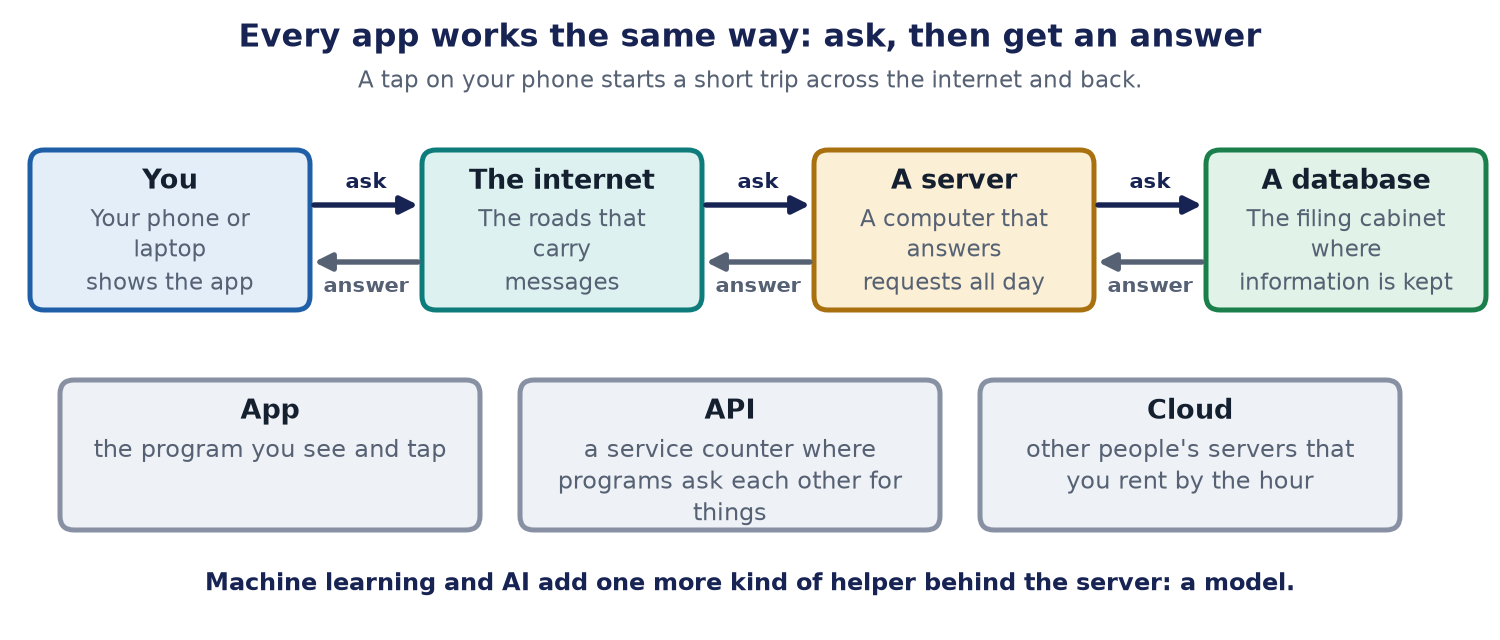
- You tap a button on your phone or laptop.
- The internet carries your request, like roads carry delivery bikes.
- A server is a computer whose job is to answer requests all day, every day.
- A database is where the server keeps information, like a very large, very tidy filing cabinet.
Then the answer travels back the same way, and your screen updates. This whole trip often takes less than a second.
Three words you will hear a lot
- App: the program you see and tap.
- API: a service counter for programs. When one program wants something from another, it asks at the counter in an agreed way, the way a customer orders at a counter. API stands for "application programming interface", but you can just think "service counter".
- Cloud: other companies' servers that you rent, instead of buying your own. Renting means you can use a lot of computing power for a short time and pay only for what you use.
Where AI fits
An AI model is software. It usually runs on powerful servers in the cloud. An app that uses AI sends your question to the AI through an API, and the answer comes back, just like the trip in the picture.
So when you chat with an AI, you are not talking to a person inside your phone. You are sending a request across the internet to a server that runs a model.
Back to Asha
Asha's bakery already has a small website. Customers tap "Order" and the website sends a request to a server. The server writes the order in a database, which is her digital notebook. Later, the kitchen screen asks the server for today's orders and gets an answer.
Nothing in that story is AI yet. It is an ordinary app. In the next chapters, we add a helper that can understand customer messages in everyday language.
Words explained
- Hardware: the physical parts of a computer.
- Software: the instructions that tell a computer what to do.
- Server: a computer that answers requests from other computers.
- Database: an organised place where information is stored.
- API: the agreed way for one program to ask another for something.
- Cloud: computers you rent from a provider over the internet.
The limits of this simple picture
- Real systems have many more parts, for example load balancers, caches and security layers. We left them out to keep the idea clear.
- "Under a second" is typical, not guaranteed. Slow networks and busy servers can take longer.
- Not every AI runs in the cloud. Some small models run on your own phone or laptop.
For engineers
- The ask and answer trip is usually HTTP: a client sends a request with a method (such as GET or POST), a path, headers and a body, and the server returns a status code and a body. Many APIs use JSON as the body format and follow REST conventions.
- Web servers are mostly stateless: each request carries what the server needs, and state lives in a database or a cache. This is why a server can be copied many times to handle more users.
- Calling a hosted model is just another API call: send text, receive text. The extra things to plan for are cost per call, delay (latency) and what happens when the call fails.
Check yourself
- What is the difference between hardware and software? Answer: Hardware is the physical machine. Software is the instructions it follows.
- What does a server do? Answer: It answers requests from other computers, all day long.
- In one sentence, how does an app that uses AI get its answers? Answer: It sends your question over the internet to a server that runs the model, and the answer comes back.