Books › AI Foundations: from zero
The map of this book
Who this book is for
You might be a student, a manager, a writer, a shop owner or a doctor. You might have used a chatbot and wondered how it works. You might have heard words like "model", "RAG" and "agent" and nodded along without being sure.
You do not need to know any technology. You do not need maths. You do not need to write code. If you can follow a recipe, you can follow this book.
One story runs through the book
Meet Asha. She runs a small bakery. Every day, customers send her messages: "Is the bread fresh today?" "Do you have eggless cake?" "Can I order 20 rolls for Friday?"
Asha hears that AI could help. So in each chapter we build her helper a little more. We do not write code. We learn the ideas. At every step, her helper can do something new, and at every step a new problem shows up. That is how the book is organised: idea, problem, next idea.
The map
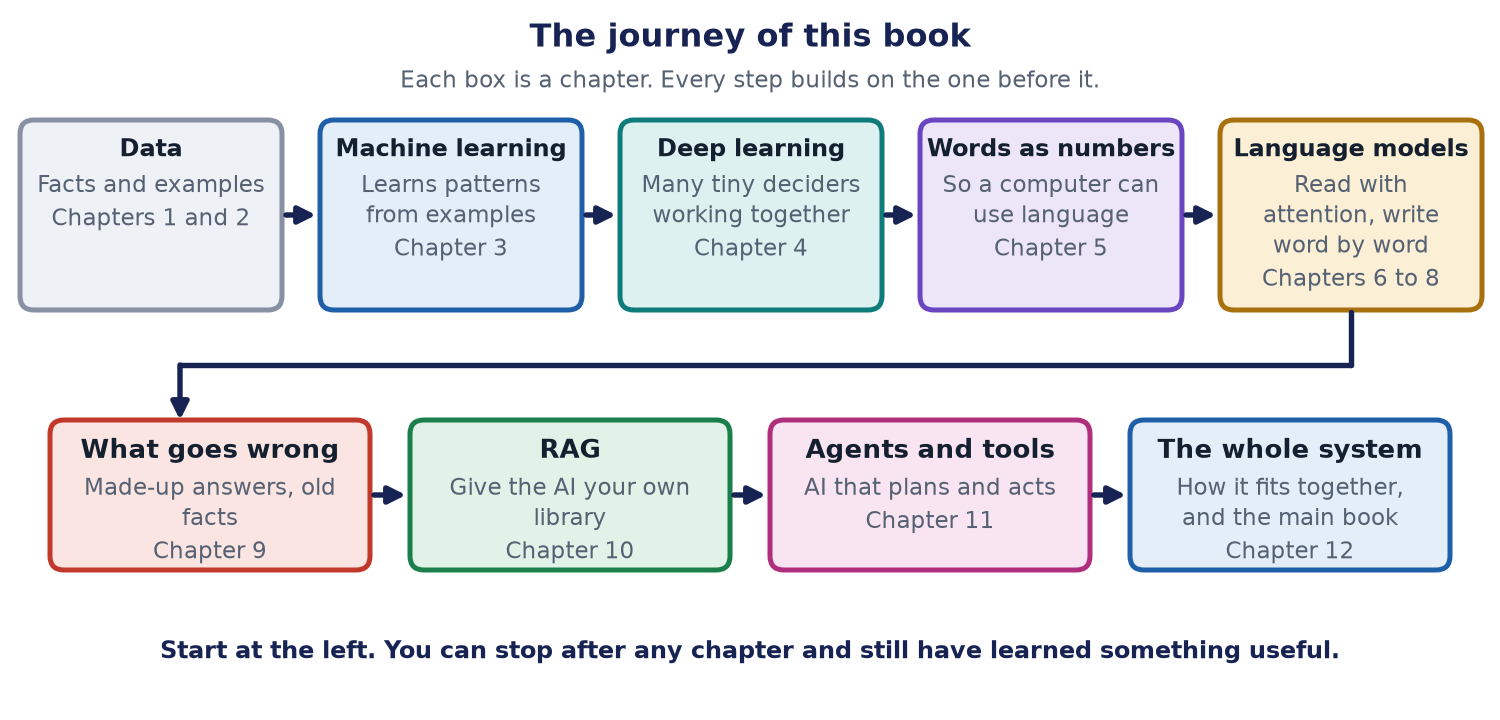
Here is the journey in five short steps:
- Computers and data (Chapters 1 and 2). What software, data and servers are, and what we mean by "AI".
- Learning (Chapters 3 and 4). How a computer can learn from examples instead of being told every rule.
- Language (Chapters 5 to 8). How words become numbers, and how a language model writes an answer one word at a time.
- Trouble and fixes (Chapters 9 and 10). Why AI sometimes makes things up, and how to give it a library to read from.
- Doing things (Chapters 11 and 12). How AI can use tools and take action, and how all the pieces fit into one careful system.
Two levels
The book has two levels, so you can go as deep as you like.
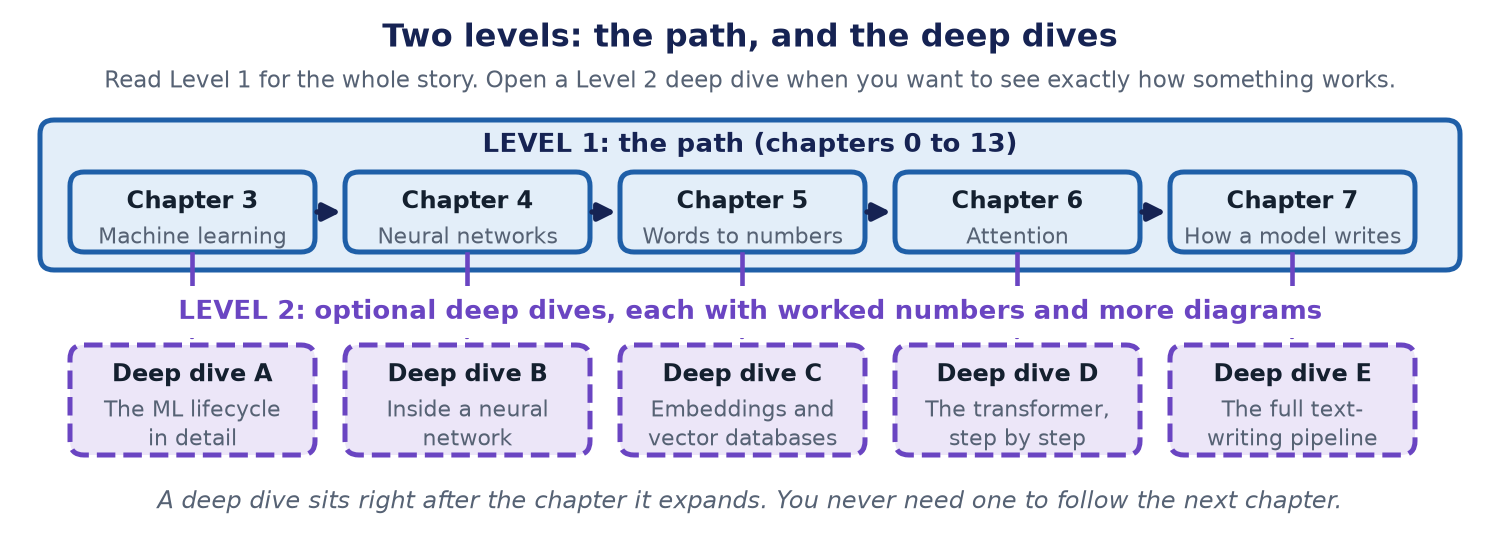
- Level 1 is the path. It tells the whole story in plain words. Read it first.
- Level 2 is the deep dives. These are optional chapters that come right after the chapter they expand. They show exactly how something works, with worked numbers and more diagrams. They are still in plain words. Skip them on a first read, and open one when you are curious.
How to read it
- Read in order. Each chapter builds on the one before. Each takes about ten minutes. Deep dives take a little longer.
- Look at the picture first. Every chapter has a diagram. If you understand the picture, you understand the idea.
- Skip the "For engineers" parts if you like. They are for people who want the exact technical names. Everything you need is above them.
- Try "Check yourself". Each chapter ends with three questions and answers. They are not a test. They help the ideas stick.
- Use the glossary. Chapter 13 lists every word in one place.
Three promises
- Plain words. Every technical word is explained the first time it appears.
- Real examples. Every idea comes with something from everyday life.
- Honesty about limits. Some ideas are simplified so they fit in your head. When a simple version hides something important, the chapter says so.
What you will be able to do
After the last chapter you will be able to:
- Explain the difference between AI, machine learning, deep learning and a language model.
- Say why a chatbot sometimes makes things up, and what helps.
- Understand what RAG and AI agents are, and why they need careful limits.
- Read the main book, From One Call to a Platform, without getting lost.
Words explained
- Model: the part of an AI system that has learned something from examples. You give it an input and it gives you an output.
- Data: information stored in a form a computer can use: numbers, text, pictures or sound.
- Chatbot: a program you talk to in everyday language.
The limits of this book
- It is simplified on purpose. It is a first map, not the whole territory.
- AI changes fast. Product names, prices and limits change often, so this book teaches ideas that last and avoids quoting numbers that go out of date.
- It is not a programming course, and it is not advice for any particular decision.
Check yourself
- Who is the running story about, and what does she want from AI? Answer: Asha, a bakery owner, who wants help answering customer messages.
- Do you need to know maths or code to read this book? Answer: No. Every idea is explained with everyday examples.
- What is the best thing to look at first in each chapter? Answer: The picture. If the picture makes sense, the idea makes sense.