Answers you can check: copy the dangerous part, don't reword it
Think of a medicine label
A pharmacist reads the dose from the label. Would you want them to say it "in their own words"? Of course not. One changed number could make you ill.
AI assistants have the same problem. They are brilliant at writing smooth sentences in their own words. But for risky steps, such as commands to type, numbers and the order of steps, "in their own words" is exactly what we do not want.
A small example
Someone asks: "How do I upgrade this system?" The official guide says:
Step 1: Make a backup.
Step 2: Run upgrade --safe
Now the AI rewords it: "Just run the upgrade." It has quietly dropped the word --safe. The upgrade might now delete things. The answer sounded helpful, and it caused a big problem.
The fix: two kinds of text
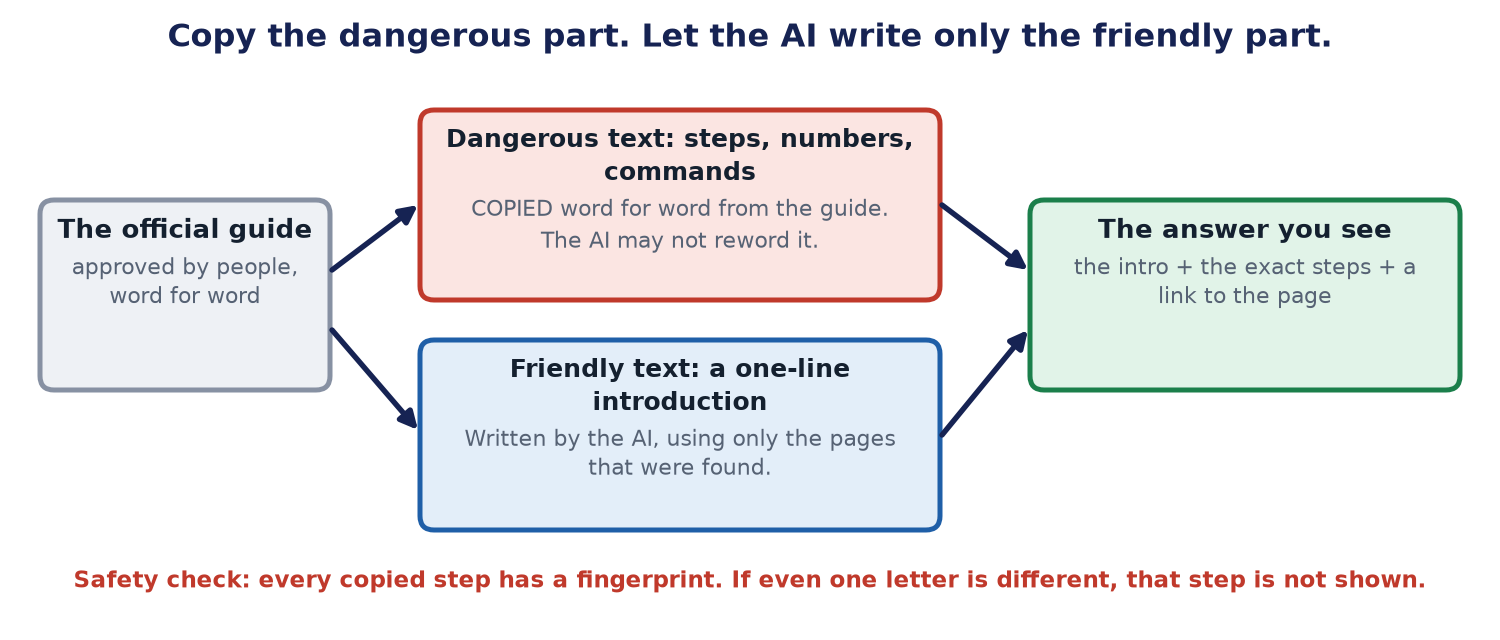
- Dangerous text (steps, numbers, commands) is copied word for word from the approved guide. The AI is not allowed to change it.
- Friendly text (a one or two sentence introduction) is written by the AI, using only the pages that were found.
Nothing else on the page is written by the AI.
Check the copy
Even a copy can go wrong, like a smudged photocopy. So when the guide is loaded, the computer makes a "fingerprint" for each step. A fingerprint is a short code that changes if even one letter changes. Before showing a step, the computer checks its fingerprint. If it does not match, the step is hidden.
Let people check too
Every answer should link to the exact page of the guide, with the passage marked. Then a person can check in seconds instead of just trusting. And when the guide does not cover the question, the assistant should say so, or ask which version the person means. It should never guess.
What to do
- Mark which parts of an answer are dangerous.
- Copy those parts exactly. Do not let the AI reword them.
- Make a fingerprint for each step, and check it before showing the step.
- Show where the answer came from.
- Say "I don't know" when the guide is silent.
The limits of this advice
- Copying exactly does not help if the guide itself is wrong or out of date. Keep the guide correct.
- People still need to read the steps. A good answer makes checking easy. It does not replace good judgement.
- Deciding which parts are "dangerous" takes care. When unsure, copy.
Words explained
- Assistant: an AI helper you ask questions.
- Approved guide: the official document that people have checked.
- Command: a line you type to tell a computer what to do.
- Fingerprint: a short code that changes if even one letter of the text changes.
- Word for word: exactly the same, with nothing changed.
For engineers
This section has the exact details. Everything above is the simple version of it.
- Assemble, don't generate. Build the answer from source blocks. The model writes only a short lead-in, constrained to the retrieved passages. Steps, numbers and commands come from the document.
- Integrity check. Store a hash (for example SHA-256) of each step block at ingestion. Recompute it before rendering. Withhold the block on a mismatch.
- Provenance. Cite document, page and passage. When the corpus does not cover the query, abstain, or ask a clarifying question about the version or variant.
- Where it fits. This is the grounding and citation pattern (Chapter 11) combined with approval for risky actions (Chapter 13).